I’ve been away from my ‘field notes blog’ for quite some time. I’m nearing the end of my PhD now, in the final leg, so I thought I’d start posting again. So, with my love of the natural world and our environment, here’s a new blog post which felt timely in the run up to Christmas and the crazy consumerism that Christmas instils upon us.
A couple of weeks ago I was queuing up in a local corner shop. The guy in front of me had just made his purchase, when his child noticed a jar of Halloween themed green eyeballs on the counter. This kid was about three, very cute with a large set of lungs.
His Dad had just bought him a kinder egg, but the kid changed his mind at the last minute.
‘I want an eyeball,’ was the clear statement that left the kid’s lips as he pointed at the jar and firmly held his dad’s gaze.
‘Come on now,’ his dad said, ‘we’ve got chocolate.’ (Waving kinder egg in front of child’s face).
‘BUT I want an eyeball.’ (Much more determined this time.)
Now, there was a moment here, when things could have swung either way as father and son eyeballed each other, and the queue (now three or four people), waited with mounting pressure for the dad to make the right decision (I’ll let you decide what that was). The kid seeing his dad wavering and evidently feeling close to getting his hands on the novelty eyeball sweet, dug in his heels and opened his lungs.
The thing that interests me here is the anticipation of the purchase. We all know that shopping gives us a dopamine hit, and releases the same feel-good hormones, but apparently so does the anticipation of getting the product.
I found this interesting article in Psychology Today, which gives us a brief overview of an experiment conducted with monkeys (that’s also something else to come back to) which showed that dopamine is released way before the reward. This means that as soon as we are scrolling, browsing, viewing – our brain is releasing dopamine anticipating the joy that is soon to be ours. The issue is, that it doesn’t last when we receive the ‘thing’, our dopamine drops and we move on to anticipating the next thing, it’s a never-ending cycle of consumerism.
None of us are immune to this. I’ve been resisting the urge to buy a mini model of Zoltar recently. It’s a mini model of a fortune telling machine, which was ironically invented as a stage prop for the film ‘Big’ featuring Tom Hanks in 1988, and then made it to arcades across the world. (There’s a whole rabbit hole to fall down here – if you want to go down that route I suggest following this link.)

Why do I want this? It brings back memories of the seaside and childhood. I love a bit of mystical novelty, so I guess owning ‘stuff’ is also a physical representation of our identity and memories. (For anyone who hasn’t come across these seaside arcade delights – the Zoltar model is a dummy in a glass case, that for the costly sum of £1 will tell you about your fortune via a little bit of card that the machine spits out). There’s a couple of these machines outside the arcades at Scarborough that are notorious for simply thieving the £1 coin and withholding the magical slip of paper that foretells your future. (Not a good omen in my opinion).
I’m anticipating having mini Zoltar sitting on my desk, spitting out daily fortunes for me and occasional visitors. The reality is that after the first few spits, is that I know that it will end up being another bit of plastic detritus collecting dust. I know that the novelty of the fortunes will wear off, and it will inevitably end up in a bag for the charity shop in around a year, when I’ve had my fun and admitted to myself that it was a useless purchase.
In an age where plastic production and plastic waste is of increasing concern, why aren’t we asking more questions about what we actually need and what we are purchasing? How do we circum-navigate the craving and the anticipation and seek dopamine rewards elsewhere?
We are bombarded with novelty everywhere we go, it’s a cheap thrill. That cute rubber duck to sit on the side of the bath. A hit of endorphins that soon wears off. I’m trying to wake myself up to consumerism and ask myself if I really need something before I buy it. I wonder if there should be higher taxes on what materials are used for, novelty being the highest? It’s not just about plastic production; it’s about using all our resources mindfully.
Like everyone else, I want to buy my children toys, I love hiking I want a great waterproof jacket and all the kit, I also love a nick knack, but what if we all consumed things more cautiously and treasured the things that we own? What if we bought the best we could afford and make it last? What if gift giving became the gift of time or experience and the items in our homes were real treasures?
And for anyone interested in making a difference here’s some ideas for alternatives to buying novelty items as gifts….
- Choose one beautiful thing over many bits of novelty. I recently bought one gorgeous silver ring for my family to give me as a birthday gift. There’s a website here aimed at just this idea: Buy Me Once.(A website aimed at selling goods that will last).
- Experiences. I’d rather have your time than a physical gift. Support a local café or attraction as a treat. (I love a visit to Harrogate Spa in Yorkshire. I also love tea and cake…hint hint).
- Buy a charitable gift (whether it’s a donation twinning someone’s toilet, or planting a tree – do good with a gift and champion our environment.)
- Make something (OK – no-one would want my baked goods) – but you get the gist. My sister just took the time to knit me a gorgeous hat and scarf, this meant way more than some plastic schizzle.
- Buy second hand, opt for circular production.
It isn’t always possible to avoid the shop counter with your kids. But here’s some other ideas for dopamine hits when we get the chance:
- Bake together. (You can get a hit of the purchase choosing and buying the ingredients).
- Create new things with pre-loved lego (we inherited loads of lego second-hand – its cheap to pick up second hand – what can you invent?)
- Game together – I fell in love with Minecraft after my son spent an hour creating a cat themed roller coaster – it’s a great tool for the imagination. It’s also great in moderation for buying a little adult headspace.
- Junk modelling – there’s nothing better than creating a junk model with items from the recycling bin. Our favourite was building model boats which we then attached to string and pulled along on our walk by the local pond.
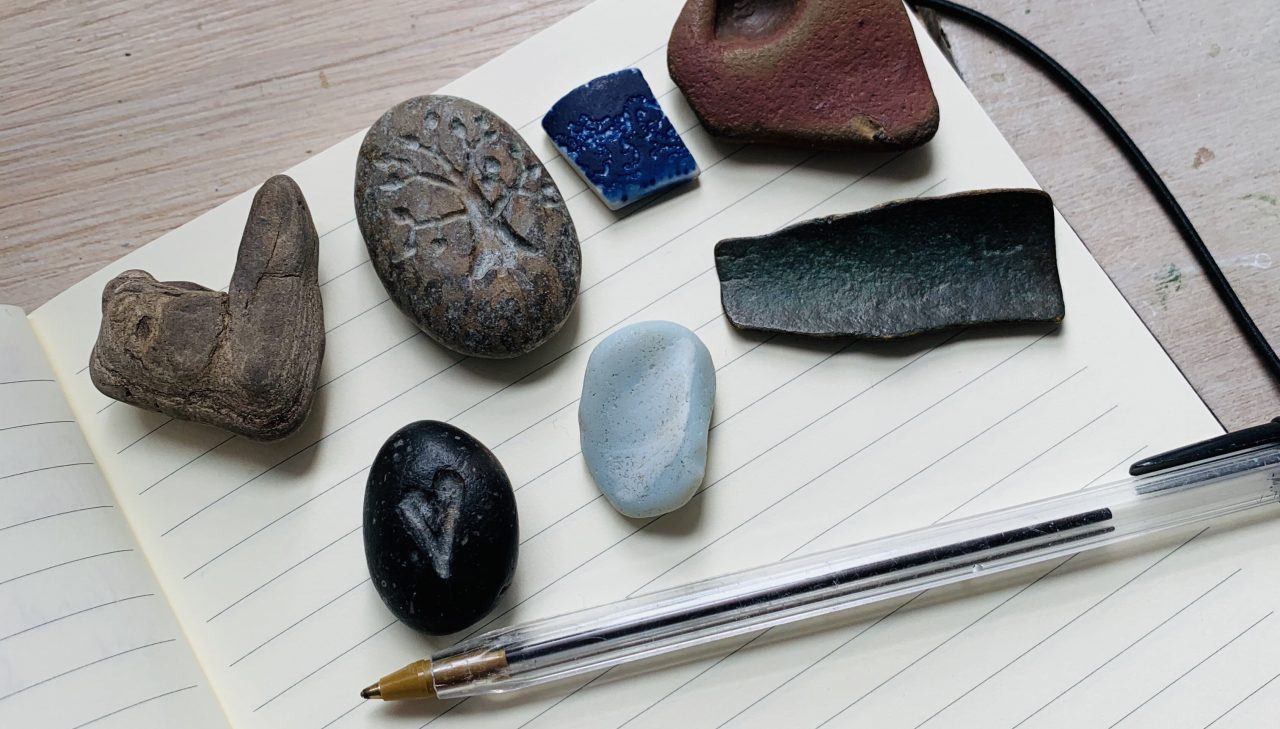
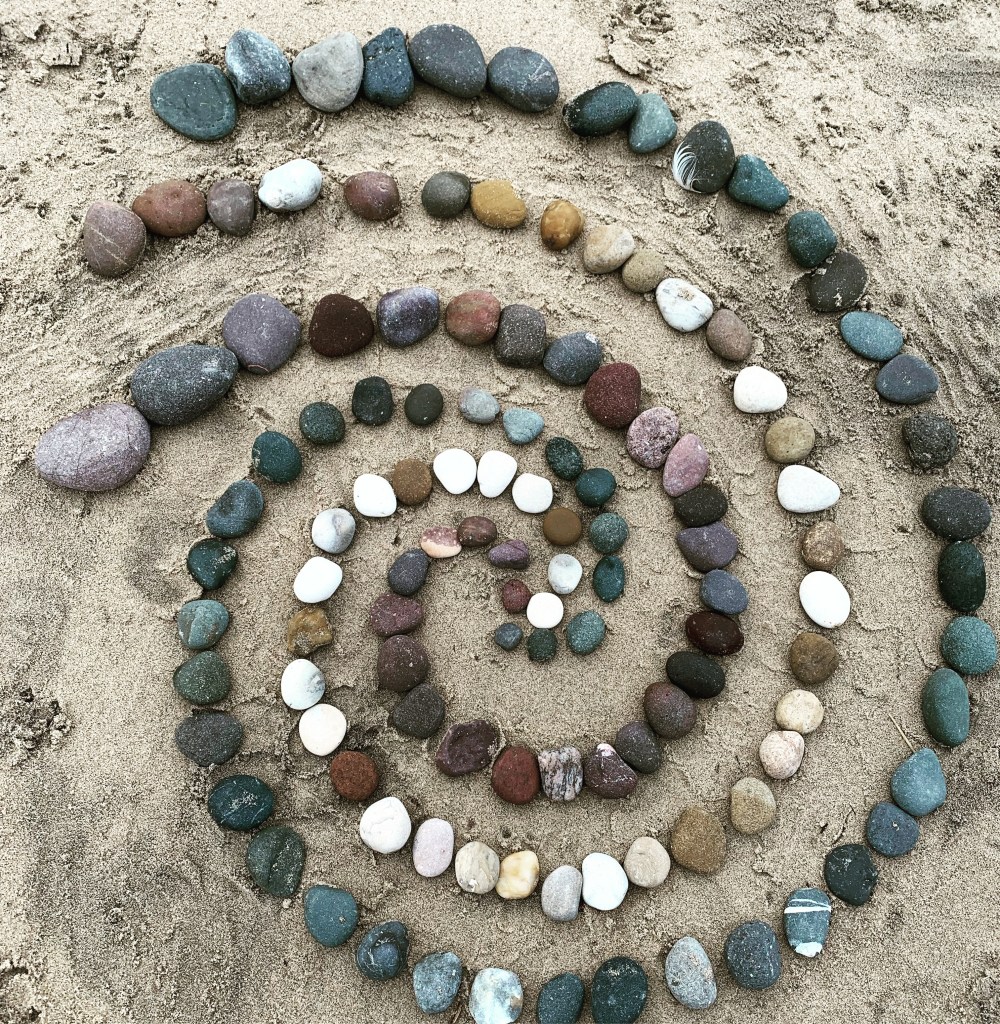
- Creating sculptures in nature – You don’t have to be a kid to do this. Andy Goldsworthy is the master. An hour out in the woods making cool stuff out of found items is a great way to spend the afternoon. Combine it with a follow up hot chocolate.
- Den building / even better a den to watch a film from. Active time with down time in den cosiness (depending on the size of the adult and the den).
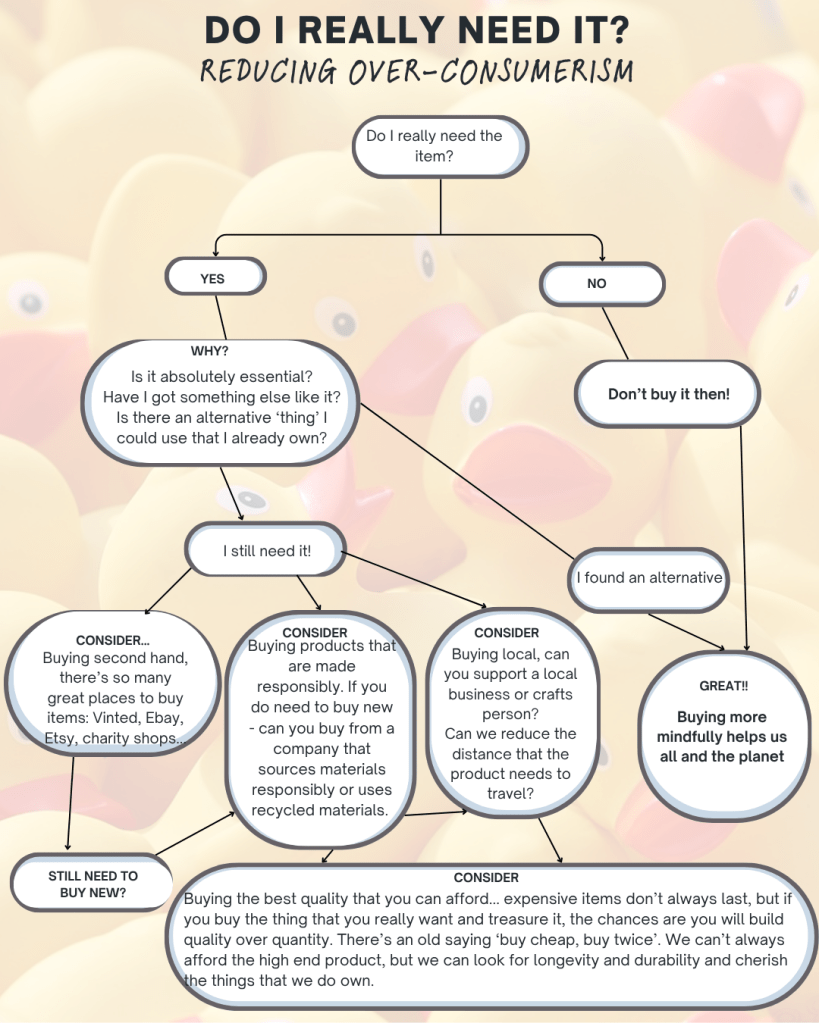
I’ve made this little chart to help make better choices when I shop, feel free to use it too.

 Adventures from Base Camp